
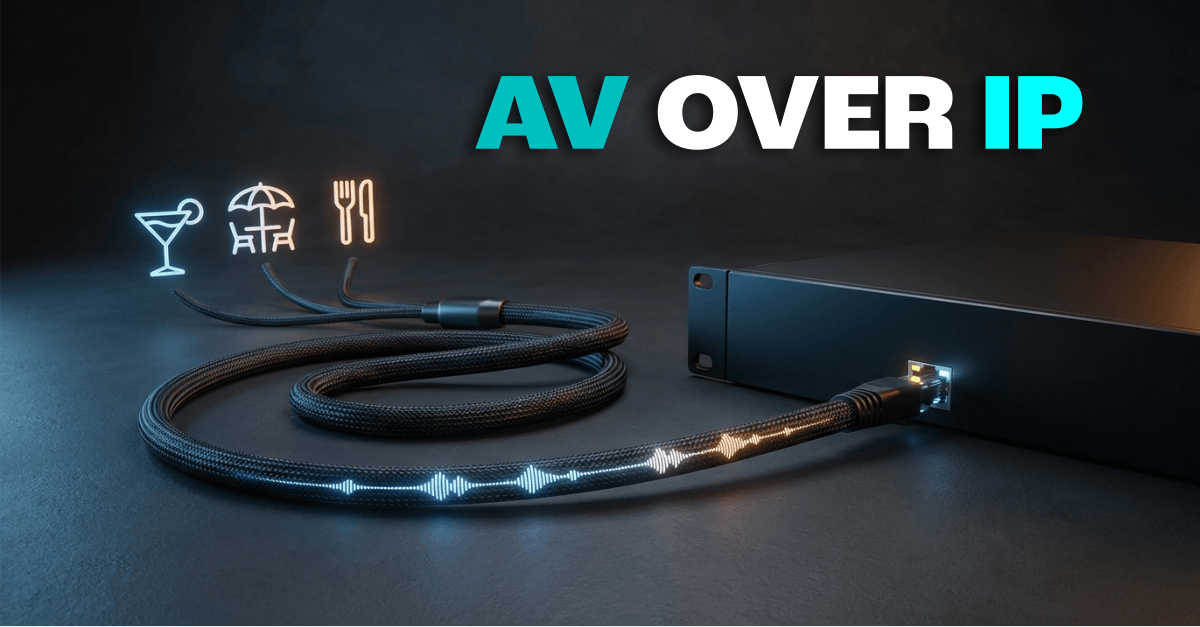
For years, a sound system in hospitality was done the way it had always been done: a separate cable for every speaker, running all the way back to a central amplifier in a technical room. Works fine, until you want to change something. An extra speaker on the new terrace, a separate zone for the upper floor, or a second music source behind the bar. Then everything is opened up and you pay for new cables throughout your venue.
More and more hospitality and retail installations run on AV over IP. Instead of a separate cable for each signal, your audio runs over an ordinary data network. The same kind of cable your internet and till system run over. For a new installation, that is the difference between something fixed in place and something that grows with you.
What AV over IP means in practice
Picture a restaurant with a dining room, a bar, a terrace and a separate space for private parties. In the old set-up you run separate cables to each zone, and if you want to change something later, another cable has to be added.
With audio over a network, via a standard such as Dante, you connect every amplifier and source to the same network. Which sound plays where is controlled in software. Different music on the terrace than in the dining room, setting the private room aside for a party, adjusting the volume per zone: it is a matter of configuring, not of running new cables.
AUDAC, the partner we work with, now builds its entire line on this. Amplifiers such as the AMP203 get both power and audio signal over a single network cable, using PoE, the same technology that also powers your network cameras. One cable to an amplifier at the source, instead of a thick bundle running back to the technical room.
Why this matters to you
The biggest advantage lies in the future. A hospitality venue changes. You expand, you refurbish, you open a terrace that was not there last year. A network-based installation grows with all of that. Adding a zone means connecting a device to the network and configuring it, not opening up your whole venue.
The second advantage is flexibility in control. A different volume for each zone, a different source, a different sound level for lunch than for the evening. You manage that centrally, and with a good system your staff do it through a simple screen or tablet without needing to understand the technology.
The third advantage is tidiness. Fewer cables through the building means fewer that go wrong, and an infrastructure an installer can still follow years later. For an architect or developer who brings AV into a project early, that is a big plus: the cabling is predictable and connects to the data infrastructure that is there anyway.
Is it more expensive?
On the equipment it can be a little more than the simplest classic set-up. But the bill that counts is the one over the years. Every change to a classic installation costs new cabling and breaking work. With a network-based installation, most changes are a matter of configuration. For a venue that is going to change over the next ten years, and which hospitality business does not change, that set-up pays for itself.
For a small venue with one space and no expansion plans, a simple classic installation is sometimes still the logical choice. We are honest about that. It depends on your plans, and we look at that together.
How to approach it
Are you refurbishing, building new or renewing your AV? Then this is the moment to choose the infrastructure well, because converting afterwards is expensive. As an AUDAC Certified Partner, we design the installation around your current space and around where you want to be in a few years’ time.
Have us come round for a survey. We look at your space, your zones and your plans, and explain what a network-based set-up gives you in concrete terms. Call 010-307 54 76 or email info@massivepro.nl.
Frequently asked questions
What is AV over IP?
AV over IP means your audio and video run over an ordinary data network, rather than over separate cables for each signal. A standard such as Dante controls which sound plays where via software.
What is the advantage over a classic sound system?
Your installation grows with you. Adding a zone or source is a matter of connecting a device and configuring it, not of running new cables. On top of that, you control each zone separately from a single central point.
Is a network-based installation more expensive?
The equipment can cost a little more, but over the years you save on changes. Every alteration to a classic installation calls for new cabling, whereas here it is often a matter of configuration.
Does this work in an existing building too?
Yes, although it is wisest to choose the infrastructure during a refurbishment or renewal, because converting afterwards is more expensive. We assess what is feasible for each situation.
What does AUDAC have to do with this?
AUDAC builds its commercial audio line on Dante and AES67, with amplifiers that get power and signal over a single network cable. As an AUDAC Certified Partner, we design and install these systems.
Read also: