
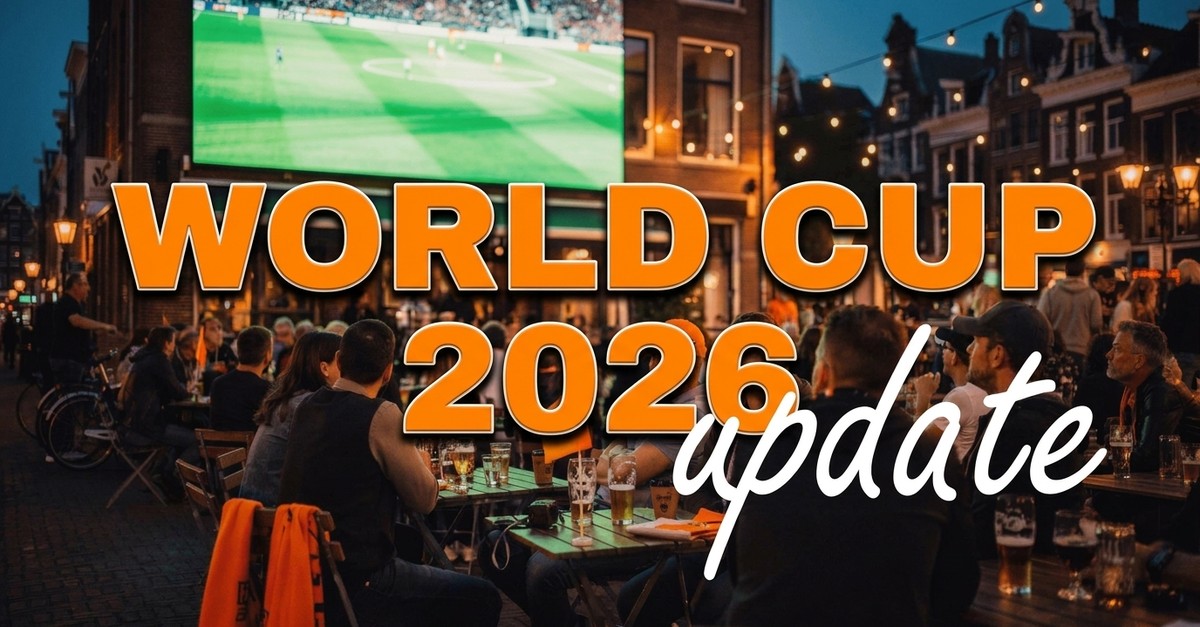
In two weeks the ball starts rolling. The World Cup 2026 runs from 11 June to 19 July 2026, and for hospitality that means five weeks of extra revenue, provided your venue can handle it. A little TV in the corner with the set’s own speakers will not cut it. Guests want to make out the commentary, hear the referee’s whistle and feel the roar of the stadium. If that does not happen, they head to the café down the road that has it sorted.
The question we get most often these past weeks: do I hire a screen now, and what else do I need? Below we set it out, including the rules to keep in mind in Amsterdam, Rotterdam and Utrecht.
First the rules, then the technology
Local councils have agreed relaxations for the World Cup 2026, but they differ from city to city. Since we are based in Rotterdam, here are the rules for this city.
Screens: especially for the World Cup you may put a screen on your terrace that is larger than the usual 55 inches. The condition is that the screen faces inwards and is not visible from the public road. So a large screen shining out onto the street will not be permitted.
Opening hours: on Friday and Saturday nights, terraces may stay open for matches that start by 00:00 at the latest and run past 02:00, on the understanding that the terrace closes no later than fifteen minutes after the match. On weekdays you may watch matches on the terrace that start at 23:00. Indoors, the same pattern applies to evening venues, with room on Friday and Saturday for a start time up to 01:00.
Sound: this is where the catch lies. At the request of Koninklijke Horeca Nederland, the council has reserved two days on which a collective festivity can be designated. Only on those two days may you stay open longer and make more noise without a late-opening permit or a noise exemption. On all other World Cup days your normal noise rules simply apply. So do not count on running at full volume all month. A sound system you can control zone by zone helps you stay within the lines without the inside falling silent.
The full text and the exact dates are on the council’s page (link at the bottom). Read it through before you commit to anything, because the scheme may still be added to. The relaxation applies up to and including 21 July 2026, so that a final that runs over is also covered.
The screen: choose by viewing distance and light
Most owners fixate on the number of inches. Far more important is where the screen hangs and how much light falls on it.
Indoors, in a café with dimmed lighting, an LED screen or a large professional display works fine. On a sunny terrace it is a different story. There you need brightness, measured in nits. An ordinary TV reaches around 300 to 500 nits and disappears in the daylight. An outdoor LED screen runs at 2,500 nits or more and stays readable, even at 18:00 in the evening sun.
Factor in viewing distance too. A rule of thumb: the width of your screen in metres times roughly 4 to 6 gives the comfortable viewing distance. If your furthest guest sits at 12 metres, you want a screen at least 2.5 to 3 metres wide. Too small and the atmosphere sags, too big and the front row ends up with a stiff neck.
Sound makes or breaks the evening
This is where the most is to be gained, and where it most often goes wrong. One speaker by the bar means half your venue cannot make anything out and the other half is shouting to be heard over it.
Spread the sound. Several smaller speakers, distributed across the room and your terrace, give an even level where everyone can follow the commentary without it hurting anyone’s ears. On the terrace you want speakers that can handle a shower, because the Dutch summer is the Dutch summer.
Do you want to switch live between commentary, a bit of music at half-time and an interview with your regular when the win comes? Then you add a small mixing desk and a wireless microphone. That turns a match into an evening.
Hire or have it installed?
For five weeks of World Cup, hiring is almost always the smart choice. You pay for the period you need it, you get equipment that suits your space, and with us it leaves the door set up and tested. No fiddling with loose cables at the busiest moment of your year.
If during the World Cup you notice that a good installation makes a lasting difference to your venue, we look further after that. Many hospitality customers start with hire for an event and later move to a fixed sound system that works all year round. But that is something for after the final.
What to do now
Three things, this week. Call your council for the exact rules and match days. Measure up your space, inside and out, and decide where the screen logically hangs. And book your hire early, because good LED screens and outdoor speakers go quickly in the World Cup weeks.
Unsure what suits your venue? We come round for a free survey, look at the location, light and sound with you, and work out what you really need. Call 010-307 54 76 or email info@massivepro.nl. The sooner, the more choice.
Rules for the city of Rotterdam
The full, official scheme for hospitality during the World Cup is here: Besluit regels voor horeca en evenementen WK voetbal 2026, gemeente Rotterdam. If you are in another municipality, check the rules for your own city, because they differ.
Frequently asked questions
When is the World Cup 2026 and how long can I broadcast?
The World Cup runs from 11 June to 19 July 2026. In Rotterdam a relaxation applies up to and including 21 July 2026. On Friday and Saturday nights, terraces may stay open for matches that start by 00:00 at the latest and run past 02:00, and on weekdays for matches that start at 23:00. Making more noise is only allowed on two days designated by the council. Check the conditions with your own council.
How big should my screen be?
Work with the viewing distance: screen width in metres times roughly 4 to 6 gives the comfortable distance. For a venue where the furthest guest sits at 12 metres, a width of 2.5 to 3 metres is a safe choice.
Can I put an ordinary TV on my terrace?
Not on a sunny terrace. An ordinary TV reaches 300 to 500 nits and disappears in the daylight. An outdoor LED screen runs at 2,500 nits or more and stays readable all evening.
May my screen be visible from the street?
No. On almost all terraces, a screen must face inwards and may not be visible from the public road. You get confirmation from your council.
Is hiring or a fixed installation better for the World Cup?
For five weeks, hiring is usually the smartest: you only pay for the period and get equipment that suits your space, set up and tested. If it proves worthwhile in the long run, we look at a fixed sound system after the World Cup.