
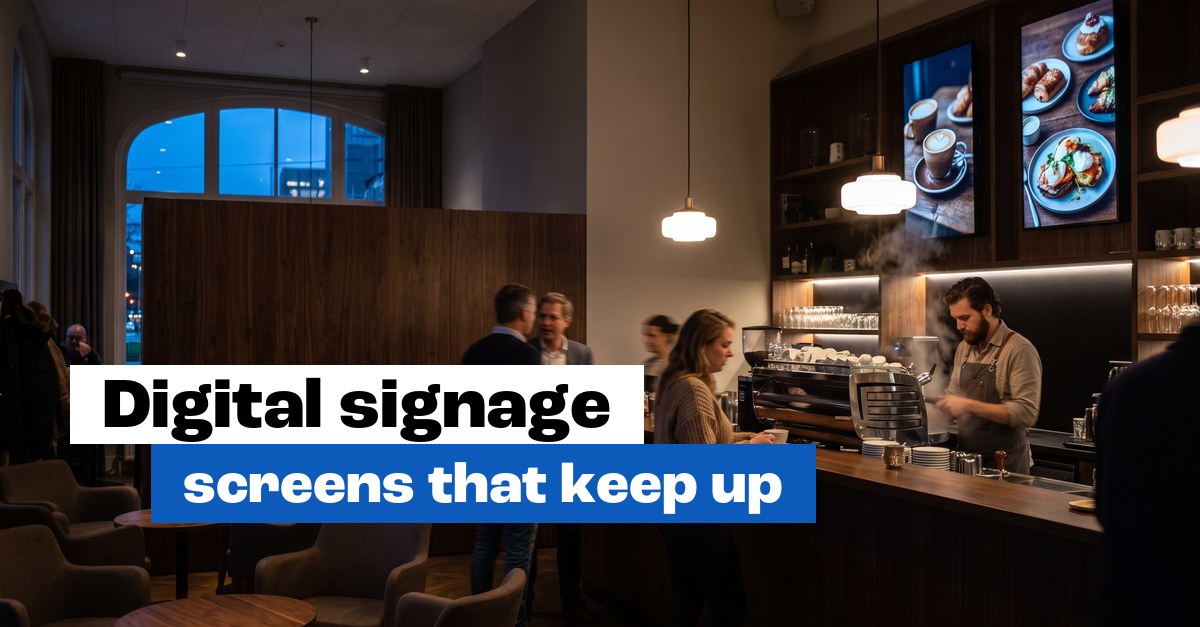
A screen on the wall showing the same poster all day is an expensive poster. For years, digital signage was exactly that: a digital noticeboard you swapped out by hand every now and then. In 2026 it can do a lot more, and the businesses using it properly get a return on it. For everyone else it stays a cost.
Whether you run a retail chain, a hospitality venue with menu boards or you’re fitting out a reception area, it pays to know what screens can do these days, and what you need to make them work.
From static board to centrally managed system
The big change is central management. With several locations or several screens, you don’t want to visit each one with a USB stick. A good signage system is managed centrally: you create content in one place and send it to the screens you choose, by location, by screen or by time of day.
That means you show a breakfast menu in the morning and a lunch offer in the afternoon, automatically, without anyone having to switch anything over. Or you roll out a promotion across all your branches at once, from your desk. In 2025 the American sports retailer Scheels put around $11 million into LED screens across all 34 of its stores, run from one central system.
Screens that adapt to your audience
The newest step is content that shifts with whoever’s watching. AI-driven digital signage can estimate the make-up of the audience and tailor the content to it. A screen that shows different messages during the day than in the evening, or that responds to how busy it is.
It can be small and low-key. In practice it comes down to your screen being more relevant to the moment, and relevant content gets watched more and sells more than a fixed loop everyone’s seen a dozen times. In retail, that helps make the shop somewhere people want to spend time.
Be careful with cameras, though. A screen that uses a camera to analyse passers-by is processing personal data, even if the images are anonymised straight away. The Dutch Data Protection Authority (Autoriteit Persoonsgegevens) generally requires explicit consent for that. Steering content by time of day, weather or how busy the venue is works fine without a camera.
The tech underneath decides whether it works
Great content on a bad screen is still a bad screen. A few things make the difference.
Screen quality and brightness: a screen behind glass or in a bright shop has to be bright enough not to look washed out. For large surfaces you increasingly see fine-pitch LED walls, which give you one picture without the bezels between separate screens.
Reliability: a signage screen often runs from opening to closing time, day in, day out. Consumer screens aren’t built for that, and commercial use often voids the warranty. You want screens made for continuous use.
Management and connections: the system has to fit the way you work. Linking it to your menu, your stock or your marketing calendar is what separates a system you use from one that gathers dust.
What we do
We design the signage system around your goal. What do you want to achieve, how many screens and locations, how do you want to manage it, and how should it look in your space? Then we install the screens, tidy the cabling out of sight and make sure you can easily run it yourself.
We look ahead too. A signage installation is an investment for years, so we choose screens and a system that grow with your plans, just like our other AV installations.
Toying with the idea of screens in your venue or branches? Have us come round for a site survey. Call +31 (0)10 307 54 76 or email info@massivepro.nl, and we’ll look at what signage can actually do for you.
Frequently asked questions
What is digital signage?
Digital signage (in the Netherlands often called narrowcasting) is showing content on screens for information, advertising or atmosphere, such as digital menu boards, window displays or LED walls. With central management, you send content to all your screens from one place.
How is it different from an ordinary TV on the wall?
A signage system is built for continuous use and central management. You change content by location, screen or time of day without walking round every screen, and you link it to your menu or marketing. An ordinary TV isn’t made for continuous use.
What can AI-driven signage do?
AI-driven signage can estimate the make-up of the audience and tailor the content to it, for example different messages during the day than in the evening. If it works with a camera, the Dutch Data Protection Authority says you’ll generally need consent from passers-by. More relevant content gets watched more and sells better than a fixed loop.
Can I link my screens to my menu or stock?
Yes. A good signage system links to your menu, stock or marketing calendar, so the content updates automatically. That’s what separates a system you use from one that gathers dust.
How do I get started with digital signage?
We start with your goal: what you want to achieve, how many screens and locations, and how you want to manage it. Based on that, we design and install a system that fits and grows with your plans.
Read also: