
The needle jumps out of the groove just as the dance floor fills up. If you’ve ever played vinyl at a party, you know that moment.
Usually it comes down to the table, the floor and where the bass ends up. And you can sort that out before the night starts.
We hire out Technics turntables in Rotterdam and the Randstad. So first, the question that comes before all of this: why would you still play records in 2026?
Vinyl or CDJ: why do DJs still play records?
CDJs have been the club standard for years. Since the Pioneer CDJ-1000 came out in 2001, a jog wheel feels roughly like a record, and these days you just play from a USB stick. Hot cues, loops, the tempo on the screen: it’s all there.
And yet plenty of riders still list 2 Technics.
First, the feel. You actually hold a record. Pulling it back, scratching, letting a track go exactly on the beat: on vinyl you feel that in your fingers. Lots of DJs reckon a jog wheel never quite gets there.
Then the mixing. A turntable has no sync button and no waveform on a screen. You match the beats with your ears and the pitch fader. Harder, yes. For many DJs that’s the fun of it.
If you play 80s house, 90s hip hop or soul, you often want people to hear the original pressings, on the kit that music was made for.
And honestly: a DJ with a crate of records stands out. You can see it from the dance floor.
What the CDJ makes easier
Vinyl comes at a price too.
- Carrying. A night’s worth of records is heavy and takes up space. A USB stick fits in your pocket.
- You play what you brought. There’s no library of thousands of tracks to fall back on.
- Wear. Records get damaged easily and wear a little every time you play them.
- A turntable feels everything. A jumping crowd, a wooden stage, a sub that’s too close. A CDJ copes with that much better, because it has no needle that can jump out of the groove.
That last one you can fix.
What happens when a turntable skips or feeds back
These are two different problems, and they often get mixed up.
Skipping comes from a knock. Someone bumps the table, the dance floor bounces, the stage is made of wood. That movement travels through the table into the turntable, and the needle hops out of the groove.
Feedback is sound coming back round. The low end from the subs and the booth monitor makes the table and the turntable vibrate along. The needle reads that vibration as music, the mixer amplifies it and the speakers play it back even louder. You hear a low rumble that keeps building, and it gets worse as the volume and the bass go up.
Hear a constant hum or buzz that’s still there with the volume down? Then the problem is usually the earthing. Check that the turntable’s earth wire is attached to the GND screw on the mixer.
For both, the same thing applies: the vibration mustn’t reach the needle. There are roughly 4 ways to do that.
1. Start with the surface
Heavy and solid vibrates less. Ideally a turntable sits on a heavy slab, on a sturdy booth, on a concrete floor. In a club with a built-in brick booth, you can do that. At a wedding in a barn or in a marquee on decking, usually not.
What you can always do:
- Use a sturdy DJ booth or a heavy table. A folding table or a high bar table gives with every knock.
- If you can, put the booth beside the dance floor instead of on it.
- Make sure nobody can lean or dance against the booth.
2. Check where the bass goes
Feedback starts in the low end. If there’s a sub right next to or under the booth, or the booth monitor points straight at the decks, you’re asking for it.
Moving a sub a few metres or turning the monitor round costs nothing. Sometimes that alone fixes it.
3. Isolation feet under the turntable
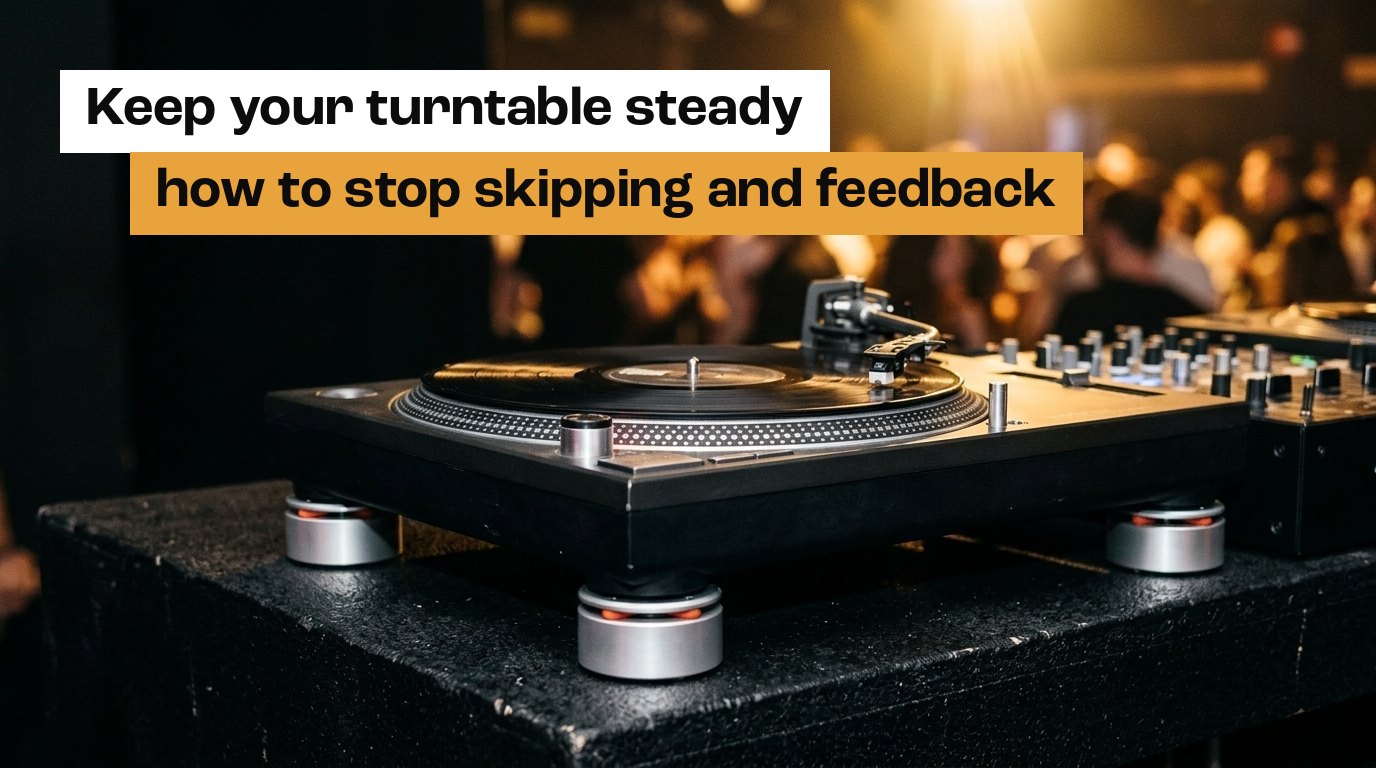
Our Technics turntables stand on Isonoe feet. Isonoe is an English brand that makes rotary DJ mixers and isolation feet, among other things.
The feet are designed for the Technics 1200. You unscrew the standard feet and screw these into the same thread, no tools needed. They’re made to fight vibration and feedback at high volume, like in clubs and on live stages.
You don’t have to do anything yourself: they come fitted as standard when you hire a Technics from us. With a sturdy table and the speakers in a sensible spot, that gets you through most parties.
4. An antishock frame for tricky floors
Sometimes the floor is the problem and you can’t change it. A wooden stage that bounces, a marquee floor on decking, a hall where the whole dance floor moves up and down. Then you want to decouple the turntable completely from whatever’s underneath.
That’s what our Earthquake antishock frame is for. The turntable sits on a steel plate that hangs from 4 rubber suspension mounts inside a frame. You use 1 frame per turntable, so a set with 2 decks needs 2. The suspension absorbs a knock or a thud in the floor before it reaches the needle.
Playing on a wooden stage, is the booth right in the middle of the crowd, or is there a heavy sub close by? Then take the frames. You can add them to your hire from €25 per frame per day excl. VAT.
And the DIY fixes?
Cushions, foam blocks, tennis balls under the decks: DJs try all sorts. Sometimes it helps, sometimes it doesn’t. Soft material acts like a spring, and whether that spring stops the low end or vibrates along with it depends on the weight of the turntable and how soft the stuff is. You can’t know that in advance. And a turntable on cushions wobbles as soon as the DJ touches a record.
At a party where it has to work, you’re better off with feet or a frame made for the job.
Checklist for your event
- Sturdy booth or heavy table, beside the dance floor
- Subs and booth monitor away from the decks, and not pointed at them
- Isonoe feet: fitted as standard under our Technics
- Wooden stage, marquee or a lot of jumping crowd: add an Earthquake frame per turntable
- Constant hum? Check the earth wire to the mixer
- Ask your DJ which turntable and mixer they’re used to
Hire a turntable set in Rotterdam
Our turntable set is 2 Technics SL-1200MK2 decks and an Allen & Heath Xone:92 mixer, for hire from €120 per day excl. VAT. A single Technics SL-1210MK2 is from €40 per day excl. VAT.
We deliver and collect the turntables ourselves, with our own team. Within Rotterdam that costs from €100 excl. VAT. As a new customer you pay a €350 deposit and we do a double ID check.
Playing vinyl soon and not sure about the floor or where the booth should go? Send us the location and a photo of the room, and we’ll help you work out the setup. See all our DJ sets or get in touch with us.
Frequently asked questions
Why does my turntable skip at parties?
Usually because of a knock that travels through the table to the needle: a bouncing dance floor, a wooden stage or someone bumping into the booth. A sturdy booth beside the dance floor, isolation feet and, if needed, an antishock frame sort that out.
What’s the difference between skipping and feedback?
Skipping comes from a knock: the needle hops out of the groove. Feedback comes from low end out of the speakers that makes the turntable vibrate. The needle picks up that vibration and the system amplifies it, so you hear a low rumble that keeps building. A constant hum that’s there even with the volume down is usually down to the earthing: check the earth wire to the mixer.
Do I need an antishock frame if isolation feet are already fitted?
On a sturdy table with the speakers in a sensible spot, usually not. On a wooden stage, a marquee floor or with a lot of jumping crowd close to the booth, the frame gives you extra peace of mind.
Can I hire a single Technics turntable?
Yes. A single Technics SL-1210MK2 is from €40 per day excl. VAT, with Isonoe feet fitted. The complete turntable set with Xone:92 mixer is from €120 per day excl. VAT.
Is playing vinyl harder than playing on CDJs?
A turntable has no sync and no screen, so you match the beats by ear. That takes more practice. So ask your DJ which setup they’re used to.
Sources: Turntable Lab, Isonoe isolation feet, Rubadub, Isonoe turntable isolation feet, Analogue Seduction, Isonoe Audio Isolation System, DJResource, Earthquake Turntable Stabilizer, DJayGEAR, Earthquake Turntable Stabilizer, Digital DJ Tips, turntables jumping, Digital DJ Tips, 7 reasons DJs still use vinyl, Divert Records, DJing with vinyl at festivals, Reverb, the CDJ platform, Wikipedia, CDJ, Wikipedia, Technics SL-1200, KB Audio, the ground on your turntable.