
You’ve booked a DJ, or you’re playing yourself. The music is ready. And then comes the question plenty of organisers get stuck on: what exactly do you hire in gear, and why?
A DJ set is more than two players and a mixer. You want a booth your DJ can work on blind, that keeps running all night without dropping out. Here’s what’s in it, and what you need per type of event.
The core: players and a mixer
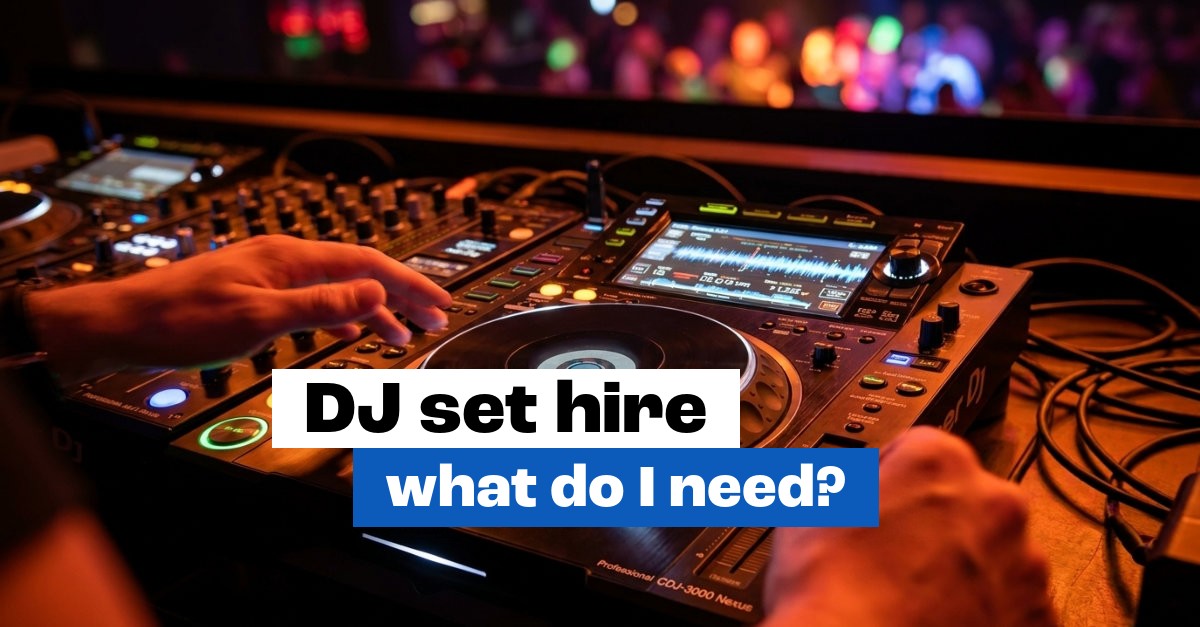
At the heart of every booth are the players and the desk they come together on. Two CDJs or two turntables, hooked up to a DJM mixer. That’s the standard almost every DJ plays on.
CDJs are the media players you see in every club and at every festival. USB stick in and go. You hire turntables if your DJ plays vinyl or wants that feel, often with hip hop, soul or an open format set.
The DJM mixer sits in between. That’s where the DJ mixes the tracks, works the EQ and the effects. Ask your DJ which model they’re used to and we’ll make sure it matches. Someone at home on a DJM shouldn’t be hunting for the right knob at your event.
Two players, or three?
Two is the minimum. A lot of DJs want a third, to work further ahead and to keep going if one starts playing up mid-set. On club nights with changing DJs you often see four CDJs, simply because the handover goes more smoothly.
Same with vinyl. Some DJs want two turntables plus a CDJ alongside, others a third player as a spare within reach. A needle that skips or an element that gives out happens quickly.
So ask your DJ not just which model they play on, but how many players they want. We take that into account when we put a booth together or pick one that fits.
Booth monitor: hearing what you’re doing
This is the one people forget most often, and it’s exactly what makes or breaks a set. Your DJ has to be able to cue the next track and hear what’s coming out of the speakers, separate from what the room hears.
That’s what the booth monitor next to the DJ is for. A separate speaker aimed at the DJ. Without it your DJ is mixing on the speakers pointing at the audience, and every transition lands just off. With a good monitor it stays tight, even when the room is full and loud.
The invisible work: DIs, cabling and earth
Between the booth and the sound system sits kit your guests never notice, and that’s the idea. DI boxes convert the signal from the booth into a form that runs cleanly over longer cables to the sound system.
Good cabling and a correct earth keep hum and noise out. Nothing is as distracting as a low buzz under the music, or a click every time someone touches the booth. We supply the DIs, the cables and the connectors that go with them, and we test the signal before the first track plays.
Backup: the party doesn’t stop
On a long night, gear runs for hours. A USB port that plays up, a cable that gives out, it happens.
The most requested form of backup is an extra player. A third CDJ in the booth, or a spare turntable next to it. If one drops out mid-set, the DJ moves across and the room notices nothing.
On top of that we bring spare cables, a second USB, and with vinyl a spare set of needles. For a company drinks, doubling up on kit is overkill. For a party of 300 on a Friday night it isn’t.
We bring it, connect it and collect it again
We don’t do bare hire where you collect the kit yourself. Partly because of the theft risk, partly because a badly connected booth costs you the whole evening.
So we drive it to your venue. We build the booth, connect it to the sound system, get the earth right, test the signal and run a track through the system before we leave. Where possible we connect the rest of the sound as well, so one party is responsible for the whole chain.
Afterwards we come and collect it. You don’t have to arrange a van, roll up cables or work out which plug goes where.
If one of our technicians is on site during the event, there’s someone next to the booth who steps in within a minute if something plays up. At bigger events we recommend it.
What do you need per event?
Running drinks for 40 colleagues at the office? Then two CDJs, a DJM and a booth monitor hooked up to a compact sound system usually covers it. Enough to carry the evening.
For a wedding or company party of 100 to 150 guests you want the same booth, with more sound around it and a tidy set-up where the DJ is visible. If a DJ turns up who’s used to their own kit, we tune the booth to that beforehand.
For a club night or festival stage you’re looking at a full booth with three or four players, a solid sound system and a set-up that covers the whole site. The bigger the event, the more it pays to have one party handle the technical side.
Book early
DJ gear goes quickly at weekends, especially in June, July and August. The earlier you call, the more choice in kit and dates.
Tell us what kind of event you’re running, how many guests you expect, which kit your DJ is used to and how many players they want. We will look at it and put together a booth that fits. Call +31-(0)10-307 54 76 or email info@massivepro.nl, and the set will be built and tested before the first track plays.
Read also:
> Dry hire or full production: which do you choose
Frequently asked questions
What’s in a complete DJ set?
Two to four CDJs or turntables, a DJM mixer, a booth monitor, DI boxes, cabling and backup kit. Hooked up to a sound system that suits your room and your guest numbers. We deliver it, connect it and collect it afterwards.
Can I collect the set myself?
No, we always deliver. It cuts the theft risk and it saves hassle: we build the booth and test it, so you know it works before your guests walk in.
Can I hire a DJ set if I’m playing myself?
Yes. We deliver the whole booth built, connected and tested. You bring your USB or records and step behind the players.
Can I get a third or fourth player?
You can. Plenty of DJs prefer three decks, and for a club night with changing DJs we put four in as standard. For vinyl we supply an extra turntable or a spare set of needles.
My DJ wants to play on familiar kit. Is that possible?
It is. Ask which model CDJs, turntables and DJM they’re used to and how many players, and we’ll tune the booth to that so everything feels familiar.
CDJ hire or turntable hire, what suits me?
CDJs are the standard and work off USB, handy for most events. You hire turntables for vinyl or an open format set. If you’re not sure, we’ll think along based on the type of music.
How far ahead should I hire a DJ set in the Randstad?
For weekends in the summer season: as early as possible. In Amsterdam, Rotterdam and Utrecht good kit is gone quickly from June to August. Booking a few weeks ahead gives you the most choice.