
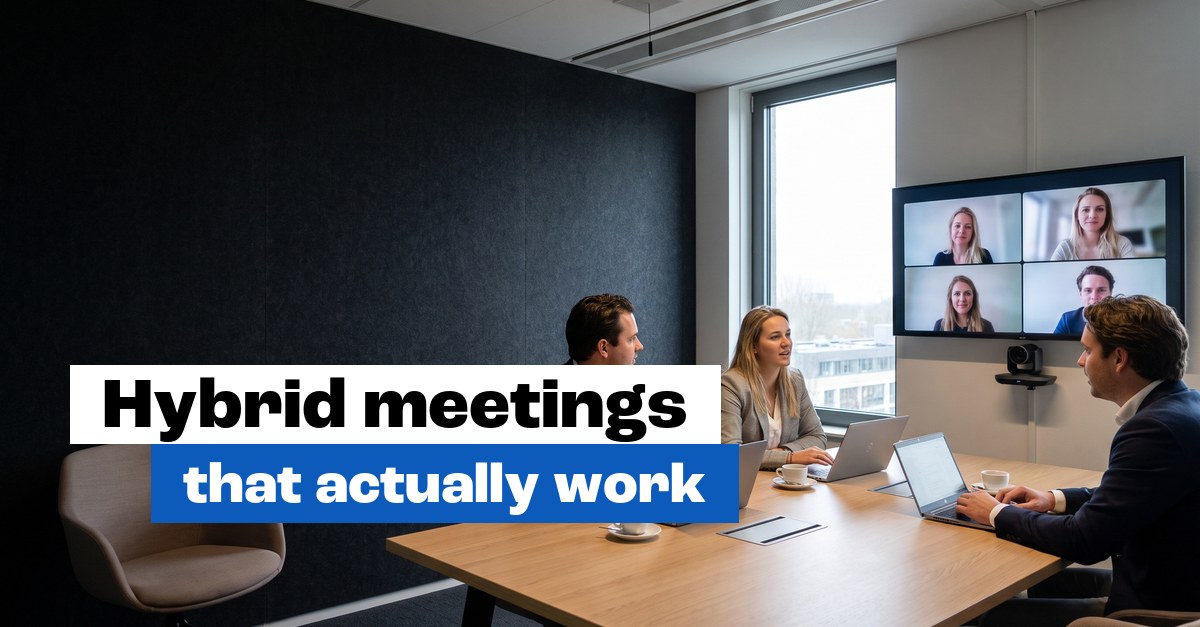
Hybrid meetings are here to stay. Some people are in the room, some join from home or from another office. Sounds simple, but everyone knows the version that fails: the people at home can’t make out what’s being said in the room, only see a table in the distance, and drift off halfway through. The tech in most meeting rooms was built for a time when everyone sat round the table in person, and it shows.
So what makes a hybrid meeting room work in 2026? Three things. And the screen, the first thing most people think of, matters less than any of them.
Sound matters more than picture
People put up with a mediocre picture for a surprisingly long time, but bad sound makes them tune out fast. If the remote participants can’t understand the room, the meeting is lost on them, however sharp the picture is.
The problem in most rooms: one microphone in the middle of the table. Anyone sitting far from it doesn’t come through well, and the reverb in the room makes it worse. The fix is audio that covers the whole table. Ceiling microphones, or a set-up that picks up several speakers, make everyone in the room clear to the people at home, wherever they’re sitting.
Acoustics are part of this. A meeting room with hard walls echoes, and that echo travels down the line with everything else. A room that’s acoustically right sounds better at both ends.
A camera that follows the conversation
The classic set-up is one fixed camera at the back, showing the whole table. The remote participants look at a cluster of distant figures and can’t tell who’s talking.
Modern systems frame automatically. The camera zooms in on whoever’s speaking, or frames the whole group neatly, and switches as the conversation moves. For the people at home, that feels like sitting at the table. With the old fixed camera it felt more like watching CCTV. Auto-framing has matured and become affordable in 2026, for ordinary meeting rooms too.
It has to work without a manual
The best tech is the tech you don’t notice. A meeting room where it takes 10 minutes to get the call going costs time and irritation every single day. The system should switch on when you walk in, connect to the software you already use, and run from a single tap on a screen.
This is exactly where it goes wrong when tech is bought piecemeal: separate parts that don’t work together. A good meeting room is designed as a whole, with screen, camera, audio and controls matched to each other and to the way you work.
Network-based, like everything else
As with other modern AV installations, meeting room tech increasingly runs over the network. That keeps the cabling simpler and makes the room easier to extend or change. For an office with several rooms, it means you set them all up and manage them the same way. Each room stops being its own little island.
For architects and developers designing offices, this is the moment to bring AV in early. The cabling, where the camera and microphones go, the acoustics: you sort those out best at the design stage, before the building goes up.
How to start
A good meeting room starts with the question of how you meet. How many people, how often it’s hybrid, which software, and what above all has to run smoothly. With that picture in hand, we design a room that works without anyone needing to understand the tech.
Want a meeting room that actually works for you, or fitting out a new office? Have us come round for a site survey. Call +31 (0)10 307 54 76 or email info@massivepro.nl, and we’ll look at your room and the way you work.
Frequently asked questions
What makes a hybrid meeting room good?
Above all good sound, a camera that follows the conversation, and controls that work without a manual. The screen, the first thing most people think of, matters less than the sound.
Why does sound matter more than picture?
People put up with a mediocre picture for a long time, but bad sound makes participants tune out quickly. If the people joining remotely can’t understand the room, the meeting is lost on them.
What is auto-framing?
Auto-framing is a camera that automatically zooms in on whoever’s speaking or frames the whole group neatly. For remote participants it feels like being in the room. In 2026 it’s mature and affordable.
Why doesn’t our current meeting room work well for hybrid?
Usually because the tech was bought piecemeal and doesn’t work together: one microphone in the middle, a fixed camera at the back, and controls that eat up time. A good room is designed as a whole.
When’s the best time to include AV in an office?
At the design stage. Cabling, where the camera and microphones go, and the acoustics are best sorted before the building is up. Changing things afterwards costs more.
Read also: